





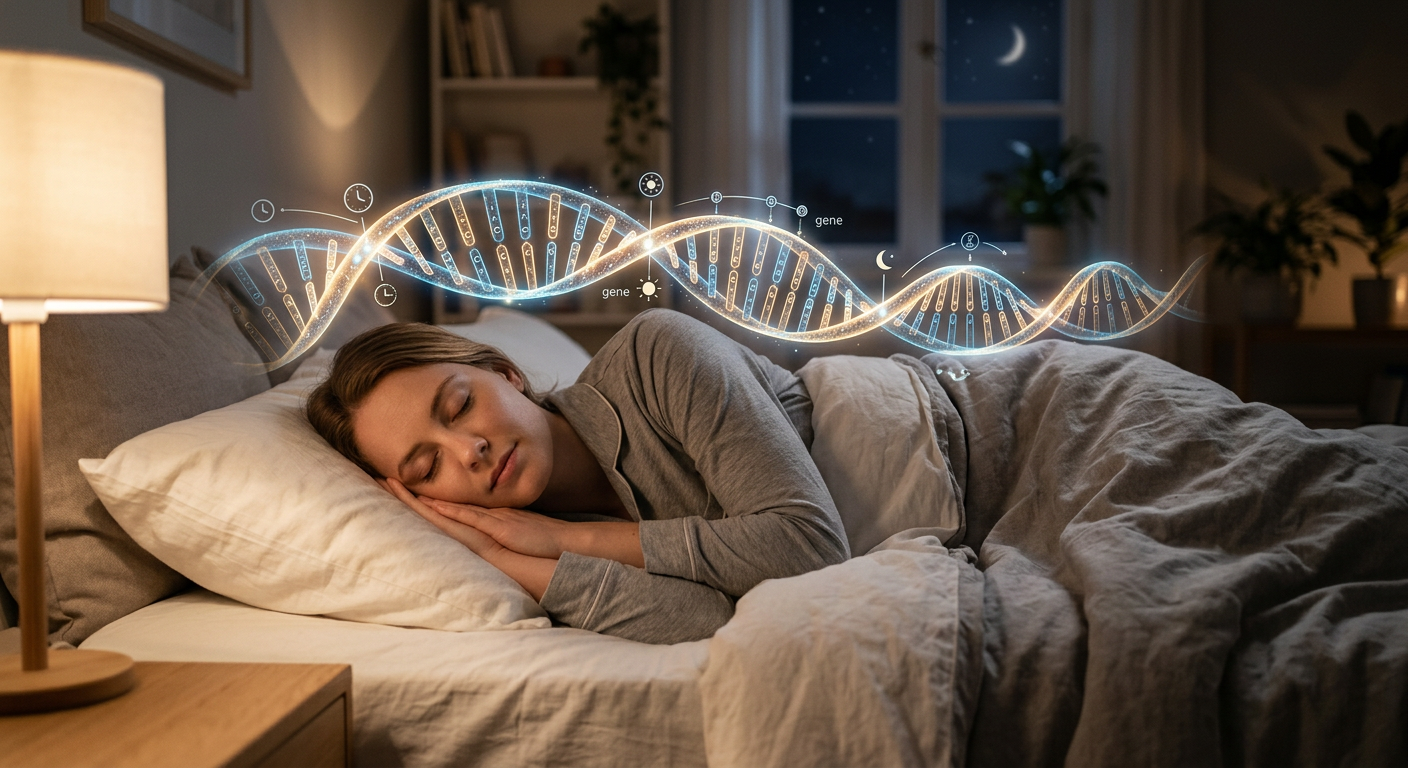
Have you ever wondered why your partner falls asleep the moment their head hits the pillow?
While you’re still staring at the ceiling an hour later, you might feel puzzled.
Moreover, why do some people spring out of bed at dawn while others feel half-dead before noon?
The answer, at least in part, lies in your genes.
Sleep is one of the most fundamental biological needs. However, it varies dramatically from person to person. How much sleep you need and when you naturally feel tired are influenced by your genes. Additionally, your vulnerability to sleep deprivation is shaped by behavioral and environmental factors. According to Harvard Medical School’s Division of Sleep Medicine, sleep is related to a complex mix of factors. These include behavioral, environmental, and genetic factors.
Different Clocks
You’ve likely heard people describe themselves as “morning people” or “night owls.” However, it turns out this isn’t just personality; it’s biology. Our internal biological clock resides in the brain. It regulates functions such as appetite, hormone release, and metabolism, and genes influence this timing. Of all the cycles controlled by the circadian system, the sleep-wake cycle is perhaps the most obvious.
Genes influence how fast our internal clock runs. They also affect how closely the clock and body functions align with the 24-hour day. Mutations from one generation to the next can affect the clock’s timing. For example, a child may have a faster or slower clock than their parents.
For most people, the circadian clock does its job quietly in the background.
For some, genetic mutations cause it to run significantly faster or slower than normal.
This leads to recognized medical conditions.
People who feel the need to go to bed very early in the evening and have very early morning awakenings are classified as having advanced sleep phase syndrome (ASPS). On the other end of the spectrum is delayed sleep phase syndrome (DSPS), where a person’s natural sleep window is pushed much later, making early morning work or school obligations genuinely difficult to meet.
Sleep Disorders
Narcolepsy, the disorder most people associate with suddenly falling asleep mid-activity, is another condition with significant genetic underpinnings.
In 1999, researchers discovered that genes cause symptoms in mice and dogs.
Moreover, these symptoms looked like the symptoms associated with narcolepsy in humans.
The narcolepsy gene in those animals produces a protein in the brain called orexin, or hypocretin, that promotes wakefulness. In humans, the brainstem area called the hypothalamus, which produces orexin, dies off, resulting in narcolepsy. Harvard’s Sleep Medicine division notes that understanding this genetic mechanism has opened significant avenues for treatment research, including drugs that target the orexin system.
Sleep apnea, in which the airway partially or completely collapses during sleep, is another condition. However, genes contribute to this trait, though the picture is more complex. Different genetic factors may be responsible for shaping the airways, the control of throat muscles, and overall breathing.
Separating these genetic factors from related conditions like obesity and hypertension makes the research challenging.
However, obesity and hypertension themselves have genetic components, which complicates the study.
One of the more striking findings in sleep genetics is that not everyone is equally harmed by a bad night.
Additionally, some people have a slight genetic variation in one or more genes.
They are more vulnerable to the adverse effects of sleep loss than the average person.
Somewhere between 10 and 20 percent of the population have this type of condition.
This has real-world implications. However, identical work schedules, shift rotations, or sleep disruptions can have very different health consequences. Depending on who is experiencing them, that difference matters. What feels manageable to one person might be genuinely harmful to another. The role of genes can influence how these effects unfold.
When your sleep patterns feel fundamentally “off,” your genes may be part of the story.
Additionally, talking to a sleep specialist, rather than simply blaming yourself, may be the first step toward real answers.
Connect with the Alaska Sleep Clinic for your free consultation today.